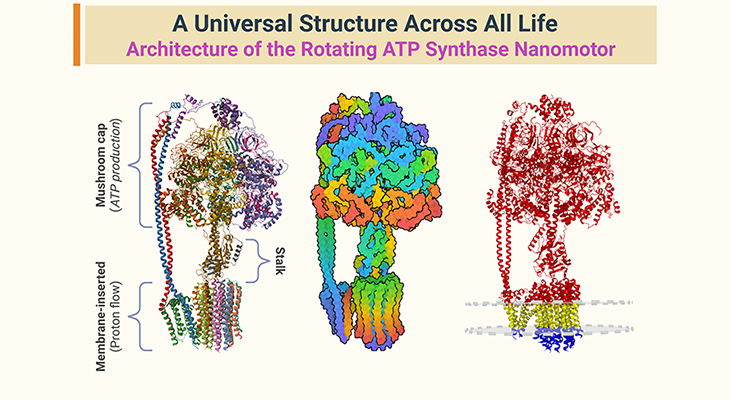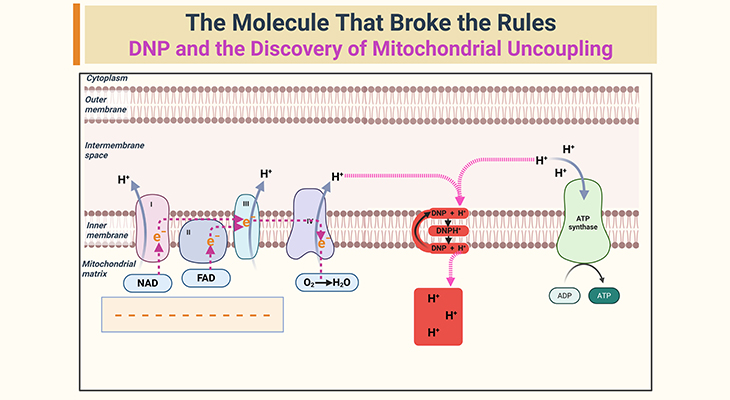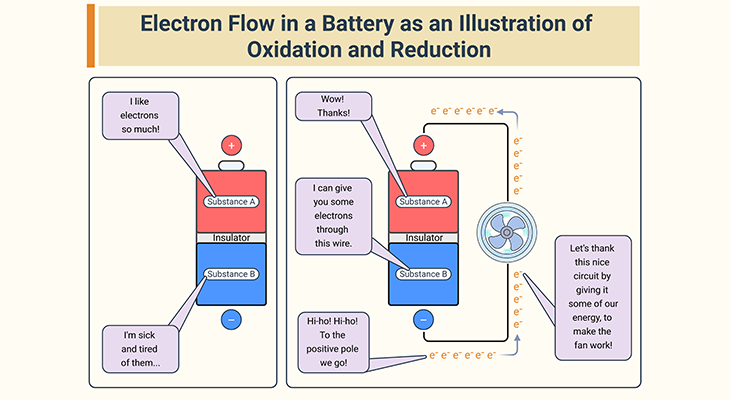
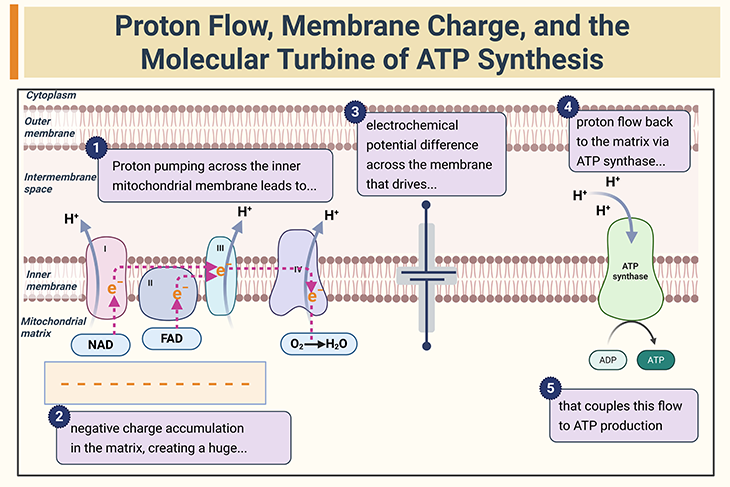
Figure 1. Proton Flow, Membrane Charge, and the Molecular Turbine of ATP Synthesis. This figure illustrates how proton pumping across the inner mitochondrial membrane is coupled to the production of ATP. As electrons from NADH and FADH₂ move through the respiratory chain and oxygen is reduced, protons are driven from the mitochondrial interior to the intermembrane space. Because these protons carry positive charge, their outward movement creates a strong electrical separation across the membrane, leaving the matrix relatively negative. The protons that accumulate outside are powerfully attracted back toward the negatively charged core but can return only through a specialized protein complex embedded in the same membrane — ATP synthase. As protons flow through this remarkable molecular machine, their movement becomes directly linked (“coupled”) to the formation of ATP, completing the final step in mitochondrial energy conversion.
Introduction
Continuing the Story of Energy: From Electrons to Life’s Final Conversion
In our previous article, we uncovered how oxidation and reduction guide the flow of electrons through living systems, and how these electrons become the true currency of biological energy. We saw how nutrients are dismantled into their smallest components, how NAD and FAD gather high-energy electrons, and how mitochondria stand ready to convert this invisible electrical potential into the ATP that powers every cell. This article continues that journey.
By the mid-20th century, scientists had already mapped the major pathways that break down carbohydrates, proteins, and fats. They understood how these nutrients were oxidized and how their electrons were transferred to NAD and FAD. Yet one profound question remained unanswered: How did these electrons, once delivered to the mitochondrial membrane, actually generate ATP?
The answer would emerge not from chemistry, but from a bold conceptual leap — the realization that the missing link was not a molecule at all, but a gradient of electrical charge across the mitochondrial inner membrane. This idea, proposed by Peter Mitchell, was so unconventional that it initially seemed impossible. But it would ultimately reshape modern biology and reveal the elegant electrochemical logic at the heart of energy production.
In this continuation, we follow the story of how Mitchell’s radical hypothesis moved from skepticism to acceptance, how key experiments transformed theory into fact, and how this discovery explains the final steps of energy conversion inside our mitochondria.
Together, we will see how electron flow, proton gradients, and ATP synthase form a seamless system that converts the food we eat and the oxygen we breathe into the energy that sustains movement, thought, growth, and life itself.
Our exploration deepens — from redox reactions to the very mechanism that powers the human cell.
The Search for the Missing Link in Energy Metabolism
Unraveling the Last Mystery of Cellular Energy (circa 1960)
By 1960, scientists had already mapped most of the major metabolic pathways, step by step, through meticulous chemical analysis. They quantified reaction products inside cells, traced individual molecular transformations, and assembled these observations into theoretical reaction sequences that were later tested and confirmed experimentally. By this time, the breakdown of glucose, as well as the fundamental metabolism of proteins and lipids, was largely understood. Yet one crucial question remained unanswered: How did the electrons carried by NAD and FAD ultimately drive the massive production of ATP inside mitochondria?
Researchers knew that NADH and FADH₂, the reduced and electron-rich forms of NAD and FAD, interacted with the mitochondrial inner membrane, where their electrons were passed through a chain of membrane-bound components and finally delivered to oxygen — the ultimate electron acceptor in human metabolism. They also knew that humans require roughly 500 liters of oxygen per day, drawn from the air we breathe, specifically so mitochondria can add electrons to this gas. In fact, mitochondria are constantly reducing oxygen to water, which we later eliminate through urine, sweat, and exhaled vapor.
Yes — your mitochondria literally manufacture water. Although this internal production amounts to only about 250–300 milliliters per day, far less than what the body needs overall, it is still a meaningful contribution. In this sense, mitochondria behave like remarkably clean biological “batteries,” generating water as the final product of their redox reactions (see Figure 1).
By 1960, scientists clearly understood that NADH and FADH₂ delivered electrons to oxygen, producing water and releasing energy in the process. They also recognized that this energy release was somehow coupled to ATP formation within the mitochondrial membrane. “Coupled” meant that the reduction of oxygen and the synthesis of ATP were interdependent: ATP was not produced unless oxygen was being reduced, and oxygen reduction was strongly inhibited whenever ATP synthesis was blocked. This tight linkage suggested that both processes were connected through a single underlying metabolic phenomenon, and the scientific community was intensely focused on discovering what created this coupling.
Up to that point, every known example of ATP production — and every known coupled metabolic process — involved specific molecules acting as intermediates. For this reason, researchers assumed that a high-energy chemical compound must connect the oxidation of NADH and FADH₂ to ATP formation. Because many high-energy molecules in metabolism contain phosphate bonds (including ATP itself), scientists nicknamed this hypothetical compound “~P” (pronounced squiggle-P), imagining it as an unknown phosphate-containing molecule that carried the missing link.
Everyone searched for ~P, believing it to be the final undiscovered step in cellular energy metabolism — the key that would complete our understanding of how the molecules we eat are fully degraded and converted into usable energy. But despite intense effort, no one could detect it. If ~P was truly central to energy production, why did it remain invisible to every experimental method available?
The Radical Idea That Changed Bioenergetics
Peter Mitchell and the Birth of a New Theory
Then came a scientist, unlike any other — Peter Mitchell, brilliant, unconventional, and unafraid of intellectual risk. He proposed a daring idea that challenged the entire field: What if the missing link between NAD/FAD oxidation and ATP production was not a molecule at all? What if the elusive ~P had never been found simply because everyone was searching for a chemical, when the true connector might be an entirely different form of stored energy — an electrical gradient across the mitochondrial membrane?
Mitchell suggested that the coupling between electron transfer and ATP synthesis might arise from a difference in charge — an electrochemical gradient — rather than from a high-energy phosphate compound. It was a radical departure from the biochemical mindset of the era.
He published this provocative idea in 1961, in the prestigious journal Nature [1]. But the reception was far from enthusiastic. His paper was notoriously difficult to read — even today, with decades of hindsight, it remains challenging. The concept was simply too foreign, too disruptive, too far outside the biochemical framework of the time. And Mitchell’s situation did not help: the paper had no co-authors, offered no experimental data, and presented only a bold theoretical model. For many scientists, it felt too speculative, too avant-garde.
Mitchell himself was a fascinating character. His intellectual interests spanned the origin of life, metabolism, architecture, and even human communication. Shortly after publishing his controversial hypothesis, he left the University of Edinburgh and continued his work in an unusual setting — a restored mansion in Cornwall called Glynn House. Supported by a charitable foundation he managed with his longtime collaborator Jennifer Moyle, Glynn House became his private research institute. The endowment that sustained it came largely from Mitchell and his brother, giving him the freedom to pursue ideas unconstrained by traditional academic structures.
All these elements — his eclectic personality, his unconventional research environment, his solitary authorship, and his purely theoretical proposal — made his concept, the Chemiosmotic Hypothesis, extremely difficult for the scientific community to accept. It was too exotic, too different, too far ahead of its time. Yet this very idea would eventually revolutionize biology.
How a Radical Theory Became the Foundation of Modern Bioenergetics
From Skepticism to Nobel Prize
The notion that NADH and FADH₂ oxidation in mitochondria might be coupled to ATP synthesis through an electrical gradient — rather than through a mysterious high-energy molecule — was initially far too unconventional for most scientists to accept. It took years of failed attempts to disprove the idea before the field slowly began to open its mind to Mitchell’s hypothesis [2].
A major turning point came from plant biologist André Jagendorf, who, like many others, had first dismissed Mitchell’s proposal outright. Jagendorf later described his reaction to Mitchell’s early lecture with striking honesty [3]: “His words went into one of my ears and out the other, leaving me feeling annoyed they had allowed such a ridiculous and incomprehensible speaker in.”
But curiosity eventually drew Jagendorf to visit Mitchell personally. That visit changed everything. Intrigued enough to test the controversial idea, Jagendorf performed a pivotal experiment showing that ATP synthesis in plant chloroplasts could be driven by a gradient across the chloroplast membrane [2]. This result was exactly what Mitchell’s theory predicted.
Soon after, Mitchell and Jennifer Moyle conducted their own decisive experiments [4]. They demonstrated that simply generating an electrical gradient across the mitochondrial inner membrane was sufficient to produce ATP — even without NADH, without FADH₂, and without oxygen. By then, the Chemiosmotic Hypothesis was no longer speculative; it was experimentally validated (see Figure 1).
Its acceptance became definitive in 1978, when Peter Mitchell was awarded the Nobel Prize in Chemistry, formally recognizing the discovery that transformed our understanding of cellular energy.
How Mitochondria Actually Make ATP
Electron Flow → Proton Pumping → Electrical Gradient → ATP
Today, we know precisely how this process works. As electrons delivered by NADH and FADH₂ enter the mitochondrial inner membrane, they move through a sequence of electron-carrying proteins known collectively as the electron transport chain. Each redox reaction subtly alters the structure of these protein complexes, enabling them to pump protons (H⁺) from the mitochondrial interior into the intermembrane space.
This proton movement creates a powerful electrochemical gradient:
- The inside of the mitochondrion becomes negatively charged.
- The outside becomes positively charged due to the accumulated H⁺.
This arrangement mirrors the logic of a battery: positively charged protons outside are strongly attracted to the negatively charged interior. But the membrane itself is not permeable to protons — they cannot simply drift back in. Instead, they must pass through a specialized molecular machine: ATP synthase.
As protons flow back into the mitochondrial matrix through ATP synthase, the enzyme captures the released energy and uses it to forge the phosphate bond in ATP. This is the moment when electrical energy is converted back into chemical energy, stored in ATP’s high-energy phosphate linkage [5-6].
The Final Energy Transformation
Food → Oxidation → Electrical Gradient → ATP → Life
In essence, the energy in your food is liberated through oxidation, using the oxygen you breathe, and transformed into an electrical gradient across the mitochondrial membrane. That electrical energy is then converted into chemical energy in the form of ATP.
And ATP is the universal energy currency of life — powering:
- movement,
- thought,
- cellular repair,
- biosynthesis,
- and every process that keeps us alive.
energy that fuels our existence.
Take-Home Message
- Food becomes energy only when its electrons are harvested. Every nutrient we eat ultimately donates electrons to NAD and FAD, setting the stage for ATP production.
- Mitochondria are true cellular batteries. They convert the chemical energy of food into an electrical gradient across their inner membrane — a form of energy storage as elegant as any engineered battery.
- Oxygen is the final electron acceptor of life. We inhale nearly 500 liters of oxygen per day so mitochondria can reduce it to water — producing 250–300 mL of new water inside our cells daily.
- The chemiosmotic gradient is the missing link. The energy from electron flow is not carried by a molecule like the mythical ~P, but by a charge separation across the mitochondrial membrane.
- ATP synthase is the molecular turbine of life. Protons rushing back into the negatively charged mitochondrial interior power this enzyme to forge the high-energy phosphate bond in ATP.
- Energy conversion is beautifully cyclical. Chemical energy → electrical energy → chemical energy. This cycle fuels movement, thought, repair, growth, and every act of living.
- Peter Mitchell’s radical idea reshaped biology. His chemiosmotic hypothesis, once dismissed as incomprehensible, became the foundation of modern bioenergetics and earned the 1978 Nobel Prize in Chemistry.
- Every breath, every bite, every heartbeat is linked. Oxygen, nutrients, electrons, membranes, and ATP form a single integrated system that powers the entire human body.
(Cf. previous blog entitled as: “The Quiet Power of Electrons: Redox Reactions as the First Step in Cellular Energy.”)
Summary and Conclusions
The journey from food to cellular energy reaches its climax within the mitochondrion, where electrons harvested from nutrients finally meet oxygen — the ultimate electron acceptor of human metabolism. By the mid-20th century, scientists had already mapped the major pathways that break down carbohydrates, proteins, and lipids, and they understood how NADH and FADH₂ carried high-energy electrons to the mitochondrial inner membrane. Yet one critical question remained unanswered: How did these electrons drive the synthesis of ATP?
The search for a molecular intermediate — the mythical ~P — dominated early thinking. Researchers assumed that, like other high-energy compounds in metabolism, the missing link must be a chemical species with a phosphate bond. But despite intense effort, no such molecule could be found. This gap in understanding set the stage for a conceptual revolution.
In 1961, Peter Mitchell proposed a radical alternative: the coupling between electron flow and ATP synthesis was not mediated by a molecule at all, but by an electrochemical gradient across the mitochondrial inner membrane. His Chemiosmotic Hypothesis suggested that electron transport pumps protons (H⁺) outward, creating a charge separation — negative inside, positive outside — analogous to a battery. ATP synthase then uses the energy released as protons flow back into the matrix to forge the high-energy phosphate bond in ATP.
Initially dismissed as incomprehensible, Mitchell’s idea gained traction only after repeated attempts to disprove it failed. A pivotal experiment by André Jagendorf demonstrated that ATP synthesis in chloroplasts could be driven solely by a proton gradient. Soon after, Mitchell and Jennifer Moyle showed that an artificially imposed electrical gradient across the mitochondrial membrane was sufficient to generate ATP even in the absence of NADH, FADH₂, or oxygen. By 1978, the theory was fully accepted, earning Mitchell the Nobel Prize in Chemistry.
Today, the chemiosmotic mechanism stands as one of the most elegant principles in biology. As electrons move through the electron transport chain, redox reactions alter the conformation of membrane proteins, enabling them to pump protons outward. This creates a proton-motive force, the electrical energy that drives ATP synthase. In this way, the chemical energy of food is converted into electrical energy, and then back into chemical energy stored in ATP — the universal currency that powers movement, thought, biosynthesis, and cellular repair.
Gaps in knowledge remain, even within this well-established framework. We still seek deeper understanding of how mitochondrial structure influences proton dynamics, how variations in cristae architecture affect ATP output, and how mitochondrial dysfunction alters the efficiency of this electrochemical system in disease states. These questions shape the future of bioenergetics research, especially in fields such as neurodevelopment, aging, and metabolic disorders.
Yet the core message is clear: Our mitochondria are exquisitely engineered cellular batteries. They transform the food we eat and the oxygen we breathe into the energy that sustains life. Through the chemiosmotic mechanism, every electron, every proton, and every ATP molecule participates in a seamless cycle that powers the human body from moment to moment.
This article completes the story of how electrons become energy — and how mitochondria convert biochemical potential into the force that drives living systems.
MitoSwab™
Authoritative Mitochondrial Assessment
MitoSwab™ delivers a non-invasive, clinically validated analysis of mitochondrial function. Using a simple buccal swab, it precisely quantifies Electron Transport Chain components and Citrate Synthase activity—a definitive marker of mitochondrial content.
Clinical Correlation: 84% agreement with the gold-standard muscle biopsy.
For the initial investigation of mitochondrial dysfunction, MitoSwab™ is the proven, practical alternative to invasive procedures.
Choose the standard of simplicity. Choose MitoSwab™.

Further Reading
- MITCHELL P. Coupling of phosphorylation to electron and hydrogen transfer by a chemi-osmotic type of mechanism. Nature. 1961 Jul 8;191:144-8. doi: 10.1038/191144a0. PMID: 13771349.
https://pubmed.ncbi.nlm.nih.gov/13771349/
(The original paper that introduced the chemiosmotic hypothesis — the conceptual revolution.) - Jagendorf AT, Uribe E. ATP formation caused by acid-base transition of spinach chloroplasts. Proc Natl Acad Sci U S A. 1966 Jan;55(1):170-7. doi: 10.1073/pnas.55.1.170. PMID: 5220864; PMCID: PMC285771.
https://pubmed.ncbi.nlm.nih.gov/5220864/
https://www.pnas.org/doi/epdf/10.1073/pnas.55.1.170
(The landmark experiment showing that a proton gradient alone can drive ATP synthesis.) - Jagendorf, A.T. Chance, luck and photosynthesis research: An inside story. Photosynthesis Research 57, 215–229 (1998). https://doi.org/10.1023/A:1006097729966
https://link.springer.com/article/10.1023/A:1006097729966
(A reflective, authoritative historical account from Jagendorf himself — invaluable context for understanding how chemiosmosis gained acceptance.) - Mitchell P, Moyle J. Respiration-driven proton translocation in rat liver mitochondria. Biochem J. 1967 Dec;105(3):1147-62. doi: 10.1042/bj1051147. PMID: 16742541; PMCID: PMC1198436.
https://pubmed.ncbi.nlm.nih.gov/16742541/
https://pmc.ncbi.nlm.nih.gov/articles/PMC1198436/pdf/biochemj00736-0244.pdf
(The experimental demonstration that mitochondria pump protons across the inner membrane — confirming the proton-motive force.) - Boyer PD. The ATP synthase–a splendid molecular machine. Annu Rev Biochem. 1997;66:717-49. doi: 10.1146/annurev.biochem.66.1.717. PMID: 9242922.
https://pubmed.ncbi.nlm.nih.gov/9242922/
https://scispace.com/pdf/the-atp-synthase-a-splendid-molecular-machine-46l38xgcv7.pdf
(A definitive mechanistic review of ATP synthase — essential for understanding how the proton gradient becomes chemical energy.) - Nicholls DG, Ferguson S J. Bioenergetics 4. Academic Press. 2013 (4th ed.)
https://www.google.com/books/edition/Bioenergetics/b3fTWHBTHAAC?hl=en&gbpv=1
(A modern, authoritative synthesis of mitochondrial bioenergetics — ideal for clinicians, scientists, and educators.)