Table of Contents
- Introduction
- Metabolism: The Invisible Architecture of Life
- Metabolism: The Chemistry That Defines Life
- The Early Curiosity: How Humans First Tried to Understand Metabolism
- How Wine, Yeast, and Chemistry Revealed the Secrets of Metabolism
- The Birth of Modern Biochemistry
- The Modern Frontier: Coordination, Disease, and Precision
- Take-Home Messages
- Summary and Conclusion
- Further Reading
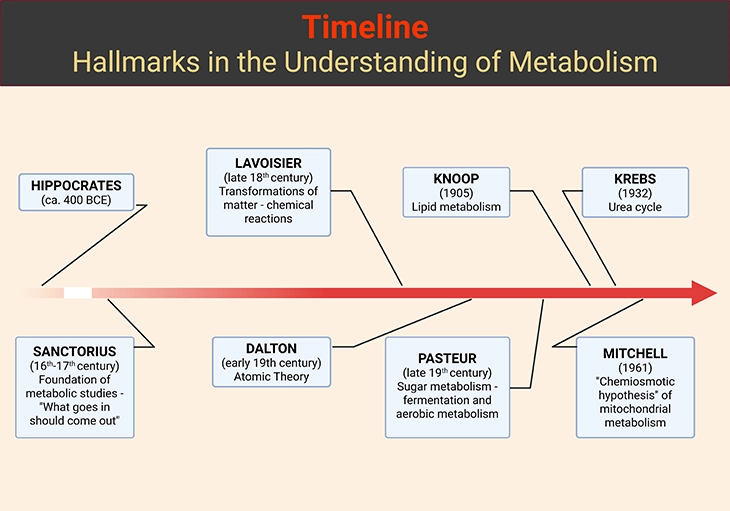
Figure 1. Milestones in the Discovery of Metabolism. (i) This timeline highlights key milestones in the evolving understanding of metabolism, tracing how early philosophical ideas matured into modern biochemical principles. Beginning with Hippocrates (ca. 400 BCE), who first proposed that health depends on the balance of internal processes, the concept of metabolism took its earliest philosophical form. In the 16th–17th century, Sanctorius introduced quantitative metabolic study by measuring body weight changes, establishing the principle that what enters the body must, in some form, leave it. (ii) In the late 18th century, Lavoisier revealed that living organisms transform matter through chemical reactions, identifying respiration as a combustion‑like process. Building on this chemical foundation, Dalton (early 19th century) formalized atomic theory, providing the structural basis for understanding metabolic transformations at the molecular level. (iii) The late 19th century brought Pasteur’s groundbreaking work on fermentation and the distinction between aerobic and anaerobic metabolism, demonstrating that microorganisms and humans share fundamental metabolic strategies. In 1905, Knoop clarified the chemical logic of lipid breakdown, marking the emergence of modern metabolic biochemistry. (iv) The 20th century saw rapid advances: Krebs (1932) discovered the urea cycle, the first cyclic metabolic pathway, revealing how organisms safely process nitrogen waste. Finally, in 1961, Mitchell proposed the chemiosmotic hypothesis, explaining how mitochondria convert nutrient‑derived energy into ATP through electrochemical gradients — a unifying principle of cellular energy metabolism.
Introduction
Metabolism: The Invisible Architecture of Life
Metabolism is often misunderstood, blamed for stubborn weight gain, sluggish energy, or the inability to “burn” certain foods. Yet metabolism is not a saboteur — it is the invisible architecture of life, the ceaseless chemistry that transforms every breath, every bite, and every heartbeat into the energy and materials that sustain us. To understand metabolism is to understand how life builds itself, repairs itself, powers itself, and ultimately persists.
At its essence, metabolism is the totality of chemical reactions occurring within living organisms to maintain life. These reactions unfold with astonishing speed and precision: tens of thousands of molecular transformations occur inside us every second, converting nutrients into energy, assembling cellular structures, eliminating waste, and orchestrating the delicate equilibrium that keeps our bodies functioning. Every living organism — from ancient bacteria to modern humans — survives because it can convert matter into energy and energy into matter, a universal principle that forms the biochemical backbone of life on Earth.
What makes metabolism even more extraordinary is its deep evolutionary continuity. The pathways that ferment sugars in yeast, the reactions that produce lactate in human muscle, and the mechanisms that power mitochondria all trace back to primordial organisms that discovered efficient ways to extract energy from their environment. These pathways were so successful that evolution preserved them for billions of years. Today, whether we are digesting food, exhaling carbon dioxide, repairing tissue, or simply existing, we rely on ancient chemical strategies perfected long before humans appeared.
Metabolism is not merely a collection of reactions; it is a dynamic, integrated system, responsive to diet, environment, genetics, and disease. It determines how we use food, how we store energy, how we grow, how we heal, and how we age. It explains why food does not simply “disappear” inside us, why weight loss literally involves exhaling carbon atoms, and why oxygen — a simple molecule — becomes the final electron acceptor that powers our cells.
To explore metabolism is to explore the story of life itself: how early thinkers puzzled over disappearing mass, how yeast taught us about human biochemistry, how mitochondria became the engines of cellular energy, and how the coordinated dance of molecules sustains every moment of human existence. This article invites readers to follow that story — from ancient curiosity to modern molecular insight — and to see metabolism not as a culprit, but as the remarkable, elegant engine that makes life possible.
Metabolism: The Chemistry That Defines Life
Metabolism often carries an undeserved reputation, blamed for weight gain, food intolerances, or an inability to “burn calories.” Yet metabolism is not a villain — it is the fundamental engine of life, the continuous flow of chemical reactions that keeps every organism alive. In fact, biologists often say that life is defined by metabolism, because anything that no longer metabolizes is, by definition, no longer alive.
What Metabolism Really Means
In its most formal sense, metabolism refers to the entire network of chemical reactions occurring inside a living organism to sustain life. These reactions are not rare or exotic — they happen every second, in every cell, and in every tissue. The word chemical itself has been unfairly maligned, yet everything we touch, breathe, eat, or are made of consists of chemical substances. Human bodies are intricate assemblies of molecules of countless shapes, sizes, and functions. These molecules form our cells and organs, and they also perform the work that keeps those cells and organs functioning.
Inside us, molecules are never static. They are constantly being broken down, rebuilt, reshaped, and reorganized through tens of thousands of chemical reactions occurring at this very moment. This perpetual transformation is the essence of metabolism. All living organisms — from bacteria to humans — must be able to modify their internal molecules and interact chemically with their environment. That is why a living human has active metabolism, while a beautifully preserved Egyptian mummy does not. The mummy’s molecules have long ceased to change; ours never stop.
Why We Must Continuously Transform What We Eat
It should feel intuitive that we are always modifying molecules inside us. After all, we routinely consume foods that look nothing like human tissue. Unless food simply vanished inside us, it must be chemically transformed. You can eat corn every day of your life without ever turning into a giant yellow kernel. Instead, your body metabolizes corn molecules, converting them into energy or transforming them into human molecules.
Corn is rich in starch, a carbohydrate that bears no resemblance to fat, yet eating excessive amounts of starch-rich foods can lead to the accumulation of fat molecules in the body. This is not magic — it is metabolism. Our cells can convert starch into glucose, glucose into acetyl‑CoA, and acetyl‑CoA into fatty acids, which are then stored as triglycerides. This elegant biochemical flexibility is what allows humans to survive in diverse environments and on varied diets.
The Early Curiosity: How Humans First Tried to Understand Metabolism
Our fascination with metabolism is ancient. Long before modern biochemistry, physicians and thinkers sensed that the way the body handled food and energy was central to health. Hippocrates (c. 460–c. 370 BC), often celebrated as one of history’s most remarkable physicians, emphasized the importance of moderate nourishment and exercise in maintaining wellbeing. His insights, recorded by biographers writing centuries later, were revolutionary for their time. In an era when diseases were commonly attributed to supernatural forces or divine punishment, Hippocrates dared to propose that illness arose from natural changes in bodily function — a conceptual leap that laid the earliest foundations for metabolic thinking (see Figure 1).
The First Metabolic Experiments: Santorio’s Missing Weight
Nearly two thousand years later, the Venetian physician Santorio Sanctorius (1561–1636 AD) performed what are now considered the first quantitative metabolic studies. In a remarkable act of scientific self‑experimentation, he meticulously weighed every gram of food and liquid he consumed and every gram of urine and stool he produced. To his astonishment, the numbers never matched. A portion of the ingested weight simply vanished [1].
Driven by curiosity, Santorio devised increasingly elaborate methods to track this missing mass. He attempted to measure sweat directly — unsuccessfully — and ultimately engineered a moveable weighing platform on which a person could sit or lie for extended periods while their body weight fluctuated. In a letter to his contemporary Galileo Galilei (1564–1642), Santorio claimed to have used this device on more than 10,000 individuals over 25 years. His conclusion was that humans lose part of their ingested matter through what he called “insensible perspiration” — a form of weight loss he could not detect or quantify.
Matter Cannot Disappear: Lavoisier’s Breakthrough
Santorio’s observations were extraordinary, but he lived too early to understand their true meaning. It was Antoine Lavoisier (1743–1794) who later established the principle that matter can change form but not mass. This insight confirmed that the “missing weight” Santorio observed could not simply vanish. Something physical — some form of matter — must have left the body.
The Atomic Explanation: Dalton and the Chemistry of Life
With John Dalton’s atomic theory (1766–1844), the basic chemistry of life finally became intelligible. Santorio, working centuries earlier, could never have imagined that the weight discrepancy he observed was due to the loss of atoms during breathing. When we exhale, the air leaving our lungs contains about 100 times more carbon dioxide than the air we inhale. That carbon dioxide carries carbon atoms — atoms that once belonged to our own molecules.
This means that when we lose weight, we are literally exhaling part of our former body. Fat molecules broken down during metabolism release carbon atoms, which leave the body as CO₂ with every breath. Santorio’s “insensible perspiration” was not sweat at all — it was carbon leaving the body through respiration, a process he could not measure with the tools of his time.
How Wine, Yeast, and Chemistry Revealed the Secrets of Metabolism
The modern understanding of metabolism began with an unexpected source: wine. In the 19th century, Louis Pasteur (1822–1895) turned to winemaking to decipher the chemical reactions that transform food inside living organisms. His insight was revolutionary — the tiny organism responsible for fermenting grape juice into wine, Saccharomyces cerevisiae (better known as Baker’s yeast), metabolizes sugars in almost the same fundamental way humans do. Pasteur was the first to recognize that microscopic living organisms — invisible to the naked eye — were driving these chemical transformations. In doing so, he became the first scientist to study metabolism as a living, chemical process [2-3].
Pasteur’s Discoveries: Efficiency and End‑Products
Pasteur uncovered two foundational principles of sugar metabolism:
- Aerobic metabolism is more efficient. He observed that yeast consumed far less sugar when oxygen was present than when it was absent. This was the earliest demonstration that oxygen dramatically increases metabolic efficiency, allowing organisms to extract more energy from the same amount of sugar.
- Different organisms produce different fermentation end‑products. Pasteur showed that some microorganisms convert sugar into lactate (as in yogurt fermentation), while others produce ethanol and carbon dioxide (as in wine, beer, and bread). These differences arise from the final reaction step, even though the earlier chemical steps are nearly identical.
Fermentation in Humans: A Shared Ancestry
Today we know that human cells behave similarly. When deprived of oxygen, our cells ferment glucose into lactate using the same chemical pathway found in yogurt‑producing bacteria. Likewise, the pathway that produces ethanol and carbon dioxide in yeast is nearly identical to lactate fermentation, differing only in the last enzymatic step.
This remarkable similarity is no coincidence. All living organisms — humans, yeast, bacteria — descend from ancient ancestors that evolved a highly efficient sugar‑metabolizing pathway. Evolution preserved this pathway because it allowed early life forms to extract maximal energy from sugar molecules, enabling them to survive and thrive in diverse environments.
The Birth of Modern Biochemistry
Pasteur’s discoveries ignited a scientific race to map the step‑by‑step transformations of metabolism. The early 1900s witnessed an explosion of breakthroughs (see Figure 1):
- 1905: The principles of lipid metabolism were described, revealing how fats are broken down and synthesized.
- 1932: The urea cycle — the first cyclic metabolic pathway — was discovered, explaining how the body safely disposes of nitrogen from protein metabolism.
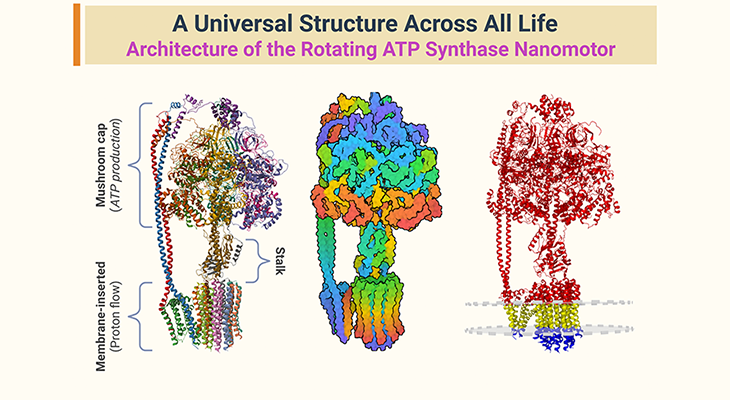
- 1961: Peter Mitchell proposed the chemiosmotic hypothesis, a monumental insight showing how mitochondria convert the energy released by nutrient oxidation (using the oxygen we breathe) into ATP through electrochemical gradients, functioning much like biological batteries.
This last discovery reshaped biology. It explained how the energy from food is ultimately transformed into the usable energy currency that powers every heartbeat, every thought, every breath.
The Modern Frontier: Coordination, Disease, and Precision
Once the major pathways were charted, scientists turned to the next challenge: understanding how thousands of chemical reactions operate in a coordinated network. Today’s research focuses on:
- how metabolic pathways communicate and regulate each other,
- how diseases such as diabetes, cancer, and neurodegeneration disrupt metabolic balance,
- and how we might fine‑tune or correct metabolic processes when they go awry.
Metabolism is no longer viewed as a simple set of chemical reactions. It is a dynamic, integrated system, responsive to diet, environment, genetics, and disease — a living choreography that sustains life.
(Cf. previous blogs entitled as: “Cellular Respiration: The Hidden Engine Driving Life’s Energy.”; “ATP: The Molecular Currency That Keeps Life Running.”)
Take‑Home Messages
- Metabolism is life in motion — the quiet chemistry that turns food, air, and sunlight into the energy that lets us think, move, heal, and simply exist.
- Every organism on Earth shares ancient metabolic pathways, inherited from early life forms that learned how to extract energy from their environment with remarkable efficiency.
- Food never vanishes inside us — its atoms are transformed, repurposed, or released, and much of weight loss is literally carbon leaving the body as exhaled CO₂.
- Oxygen is the great amplifier of life’s energy, allowing cells to harvest far more power from each sugar molecule than fermentation alone ever could.
- Fermentation is our universal fallback, a shared ancestral strategy that yeast, bacteria, and human cells use when oxygen runs low — a reminder of our deep evolutionary kinship.
- Metabolism is a coordinated symphony, not a single pathway; thousands of reactions communicate, adjust, and respond to diet, stress, disease, and environment.
- The history of metabolism is the history of curiosity, from Hippocrates’ early insights to Pasteur’s yeast experiments and Mitchell’s chemiosmotic revolution — each discovery revealing another layer of life’s hidden architecture.
- To understand metabolism is to understand ourselves, because every heartbeat, every breath, every moment of growth or repair is powered by the elegant choreography of molecules in motion.
Summary and Conclusion
Metabolism is the continuous, life‑sustaining chemistry that transforms matter and energy within every living organism. It is the quiet engine that powers growth, repair, movement, thought, and survival — a vast network of reactions unfolding with exquisite coordination. From ancient microorganisms to modern humans, the core logic of metabolism has remained remarkably conserved, reflecting billions of years of evolutionary refinement. This shared biochemical heritage explains why yeast, bacteria, plants, and humans rely on fundamentally similar strategies to extract energy from their environment and convert molecules into the building blocks of life.
Across history, our understanding of metabolism has evolved from simple observations of disappearing mass to the recognition of complex, interconnected pathways that operate with precision and adaptability. We now appreciate metabolism as a dynamic system that responds to oxygen availability, nutrient supply, environmental stress, and physiological demand. It is not a single pathway but a living network, capable of shifting gears, rerouting intermediates, and maintaining balance even under changing conditions. This universality makes metabolism both profoundly simple in its purpose and astonishingly complex in its execution.
Yet despite centuries of discovery, major gaps in knowledge remain. We still do not fully understand how thousands of metabolic reactions coordinate across tissues, how metabolic signals integrate with hormonal and neural networks, or how subtle variations in metabolic efficiency influence aging, resilience, and disease susceptibility. The interplay between metabolism and immune function, the metabolic signatures of chronic diseases, and the role of metabolism in cellular identity and regeneration remain active frontiers. Even more enigmatic is how metabolism shapes behavior, cognition, and long‑term physiological adaptation — questions that bridge biology, medicine, and neuroscience.
Looking ahead, the future of metabolic science lies in unraveling these layers of complexity. Emerging tools in systems biology, single‑cell analysis, metabolomics, and computational modeling promise to illuminate how metabolic networks behave as unified systems rather than isolated pathways. Understanding these interactions will be essential for developing precise interventions that restore metabolic balance in disease, enhance human performance, and promote healthy aging. As we deepen our knowledge, metabolism will continue to reveal itself not merely as a set of chemical reactions, but as the fundamental choreography of life, connecting every organism through the shared language of molecules in motion.
This universal foundation prepares us to explore specific metabolic pathways in greater detail — each one a chapter in the larger story of how living systems transform the world around them into the energy and matter that sustain existence.
MitoSwab™
Authoritative Mitochondrial Assessment
MitoSwab™ delivers a non-invasive, clinically validated analysis of mitochondrial function. Using a simple buccal swab, it precisely quantifies Electron Transport Chain components and Citrate Synthase activity—a definitive marker of mitochondrial content.
Clinical Correlation: 84% agreement with the gold-standard muscle biopsy.
For the initial investigation of mitochondrial dysfunction, MitoSwab™ is the proven, practical alternative to invasive procedures.
Choose the standard of simplicity. Choose MitoSwab™.

Further Reading
- Eknoyan G. Santorio Sanctorius (1561-1636) – founding father of metabolic balance studies. Am J Nephrol. 1999;19(2):226-33. doi: 10.1159/000013455. PMID: 10213823.
https://pubmed.ncbi.nlm.nih.gov/10213823/
(A brief historical portrait of Sanctorius, whose meticulous measurements founded the modern concept of metabolic balance.) - Schwartz M. The life and works of Louis Pasteur. J Appl Microbiol. 2001 Oct;91(4):597-601. doi: 10.1046/j.1365-2672.2001.01495.x. PMID: 11576293.
https://pubmed.ncbi.nlm.nih.gov/11576293/
(A concise biographical account tracing how Pasteur’s discoveries in fermentation and microbes transformed biological science.) - Berche P. Louis Pasteur, from crystals of life to vaccination. Clin Microbiol Infect. 2012 Oct;18 Suppl 5:1-6. doi: 10.1111/j.1469-0691.2012.03945.x. Epub 2012 Aug 6. PMID: 22882766.
https://pubmed.ncbi.nlm.nih.gov/22882766/
https://www.clinicalmicrobiologyandinfection.org/action/showPdf?pii=S1198-743X%2814%2961355-0
(A sharp overview of Pasteur’s journey from molecular asymmetry to fermentation and ultimately to the birth of vaccination.)